
Photo Gallery
Step into the past and witness the powerful stories of American service and sacrifice through our immersive exhibits at the National Museum of Military Vehicles. Each exhibit captures the remarkable artifacts, historic military vehicles, and compelling personal stories that define our nation’s history. From the musket that fired the first shot at the Battle of Bunker Hill to the legendary Sherman tanks of WWII, our galleries offer a glimpse into the courage, innovation, and resilience that shaped America. But these photos are just the beginning—there is so much more to see, from immersive dioramas to rare artifacts that bring history to life. Explore these moments in time—then visit us to experience the full story for yourself!
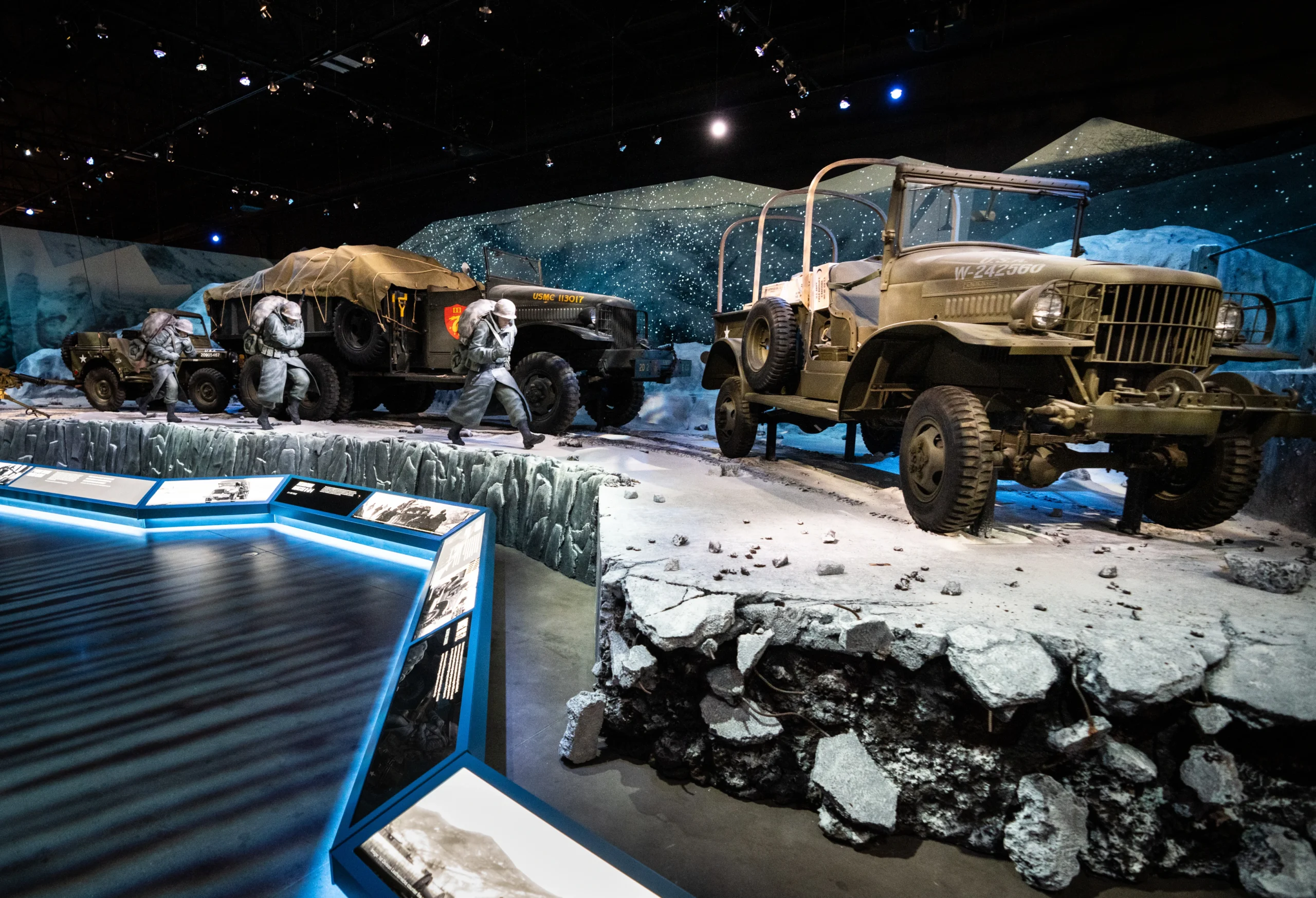
The Battle of Chosin Reservoir: A Defining Moment of the Korean War.

LVT (Landing Vehicle Tracked): Designed to cross coral reefs, penetrate the surf line, and move beyond the water’s edge.

M4A3E8 Sherman Tank: One of the iconic exhibits in The National Museum of Military Vehicles

DUKW: Functioning as both a truck and a boat, the vehicle was indispensable to the World War II effort.

First Lieutenant Baldomero López was immortalized in an iconic photograph taken as he led his men over the seawall during the Battle of Inchon, reportedly shouting, “Follow me!”

German Army Standard Light Field Howitzer, the 10.5cm LeFH 18M Field Howitzer (left), was the standard German divisional field howitzer (direct support) used during World War II.

In the summer of 1944, Germany started development of a secret weapon, the Natter (“viper” or “snake”). Constructed mostly of wood, in its single manned test flight, Luftwaffe pilot Lothar Sieber died when the canopy unexpectedly separated from the aircraft.

The UH-1 Iroquois, the “Huey,” was the Vietnam War’s iconic helicopter. First flown in 1956, the initial UH-1A deployed to Vietnam in March 1962.

Facing relentless and highly effective Viet Cong (VC) and North Vietnamese Army (NVA) ambushes, American G.I.s in Vietnam developed the “Gun Truck” concept—a battlefield innovation born out of necessity.

A visually and audibly intense recreation of nighttime jungle warfare in Vietnam. The exhibit brings to life the harrowing conditions soldiers faced, from booby traps and land mines to the hidden entrance of a Viet Cong tunnel complex and a fortified North Vietnamese Army bunker.

The Vietnam War was the first conflict broadcast directly into living rooms worldwide, bringing the brutal realities of combat into sharp focus through television. CBS anchorman Walter Cronkite traveled to South Vietnam to see the situation firsthand.

One of the most prized artifacts at The National Museum of Military Vehicles is the rifle that fired the first shot at the Battle of Bunker Hill. This .79-caliber Dutch flintlock musket, complete with its original bayonet, once belonged to Private John Simpson, a soldier in the New Hampshire militia who played a pivotal role in the opening moments of the historic battle.
One of the most prized artifacts at The National Museum of Military Vehicles is the rifle that fired the first shot at the Battle of Bunker Hill. This .79-caliber Dutch flintlock musket, complete with its original bayonet, once belonged to Private John Simpson, a soldier in the New Hampshire militia who played a pivotal role in the opening moments of the historic battle.