Needle in a Haystack: The Luck of the Irish
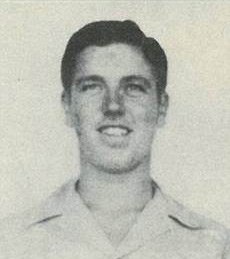
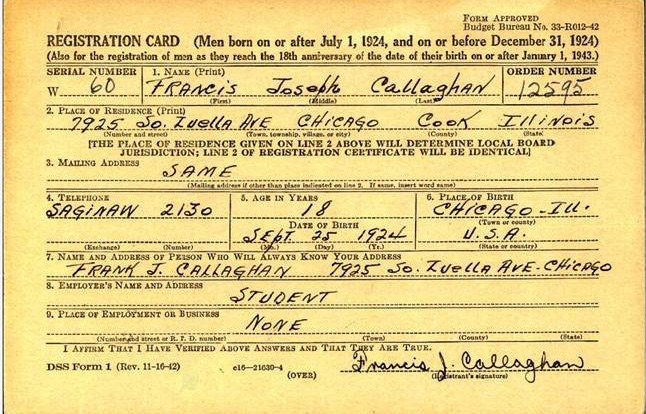
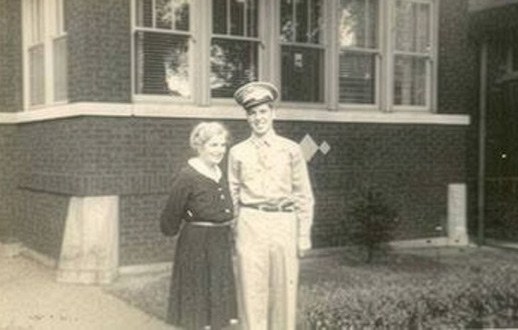
Francis Callaghan, a native of Chicago’s South Side, was born on September 25, 1924. Shortly after his high school graduation in 1943, Callaghan received a draft notice for the U.S. Army.
After receiving his basic Army training at Camp Beale, California, Francis was assigned to the 530th Engineer Light Pontoon Company (a bridging company that used pneumatic pontoons on which to lay bridging materials). The 530th was formed on June 25, 1943, at Camp Beale, California, by a group of officers from the Fort Belvoir Engineer School and a cadre from the 73rd Engineer Light Pontoon Company. Training for the engineers was conducted at Camp Beale, from the fall of 1943 into the Spring of 1944.
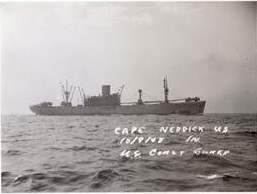
On April 21, 1944, the 530th departed San Francisco aboard the SS Cape Neddick . After 26 unescorted days at sea, the unit went ashore at Finschhafen, located on the South Pacific island of New Guinea.
After their arrival in New Guinea, the unit trained while getting acclimated to the tropical environment of the western Pacific. By October, the men of the 530th were ready for combat.
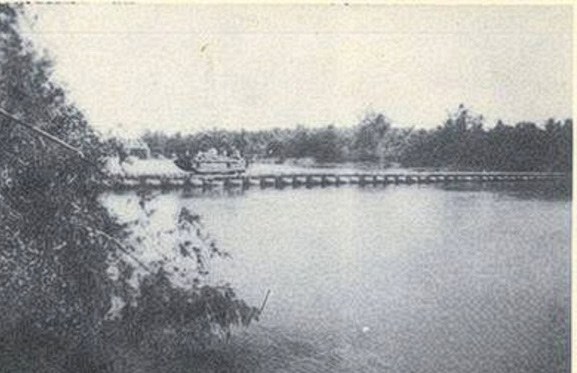
The 530th was a separate, independent unit assigned to the U.S. Sixth Army. The Company was composed of 205 men and six officers. The unit was broken down into three line platoons who were tasked with transporting, constructing, and maintaining two ten-ton floating bridges, twelve units of infantry support raft, and 432 feet of infantry footbridge. The Company also maintained 70 boats, which were used during river assault crossings.
In October the unit experienced combat for the first time when it supplied bridging for the landings of the 96th and 7th Divisions on the Philippine island of Leyte.
From October through December 1944, the unit supported the XXIV Corps in combat operations during the liberation of Leyte Island, the first Philippine territory retaken by the Americans. Callaghan witnessed Japanese aircraft and kamikazes attack the U.S. Navy fleet during the initial landings.
In January 1945, Francis and the 530th took part in the second Battle of the Philippines. Attached to the XIV Corps, the 530th provided bridging across the Agno River for the 40th Division during the initial stages of the campaign, after which they spearheaded the 37th Division’s push south, toward the capital of Manila.
By early February 1945, the unit was near Manilla and were constructing a bridge across the Pasig River. However, Callaghan had other things on his mind. He was determined to find his aunt and uncle, Sam and Cecilia Ladic, and their three young daughters who were imprisoned somewhere in a cluster of prison camps north of the Pasig River.
Before the war, Sam Ladic had managed a gold mine in northern Luzon, but the family was captured by the Japanese after the surrender of the Philippines in 1942. Since their capture, the entire Ladic family had lived a nightmare existence.
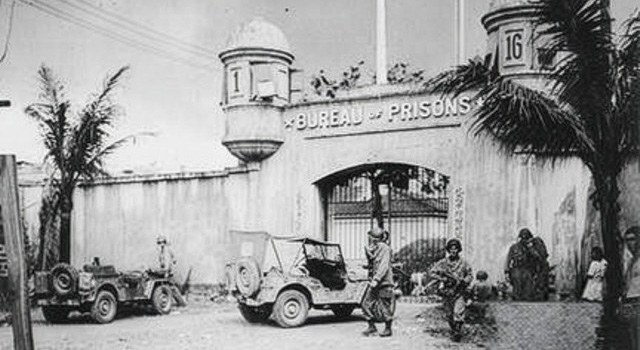
Now three years later, the reports were that the Ladics, were imprisoned in the notorious Bilibid Prison, just two miles north of where Callaghan’s unit was bridging the Pasig River.
Once the bridge was completed, Corporal Callaghan hounded his commander for permission to go search for his relatives.
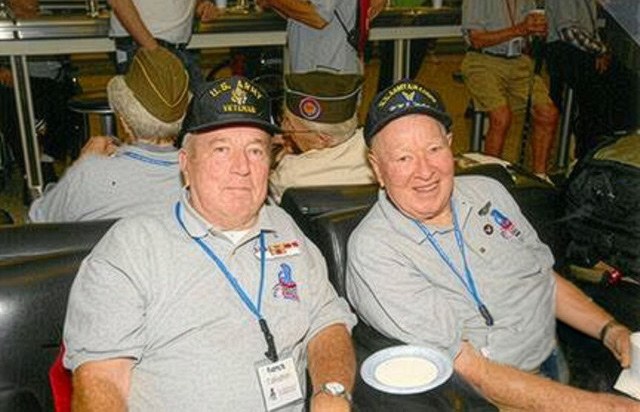
“He gave me permission after a while,” recalled Francis during an oral history interview over 70 years later, “and then he said, ‘I think you’re crazy. There’s still fighting going on!’”
Francis left anyway, working his way north through the deserted streets of the city, past dead bodies and the debris of battle, along streets still plagued by Japanese snipers. There were no signs of Japanese guards when Callaghan reached Bilibid Prison. They had fled when an American armored unit moved through the area. There was also no sign of American troops who had bypassed the prison in pursuit of the Japanese.
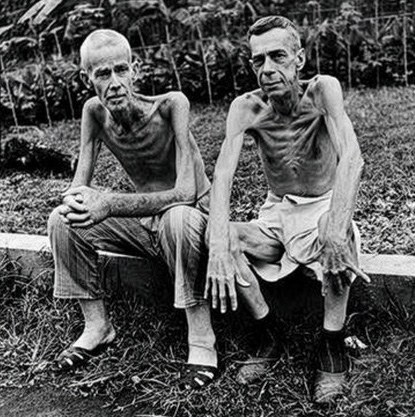
What Callaghan saw first at Bilibid were the Bataan Death March survivors in an enclosure built more like a lion’s cage than a prison cell. They were little more than skin and bones.
“They reached through the wire fence and wanted to shake my hand, and wanted cigarettes and candy,” said Francis. When Francis asked the POWs about his family’s whereabouts, the prisoners pointed him in the right direction. Francis soon found his relatives.
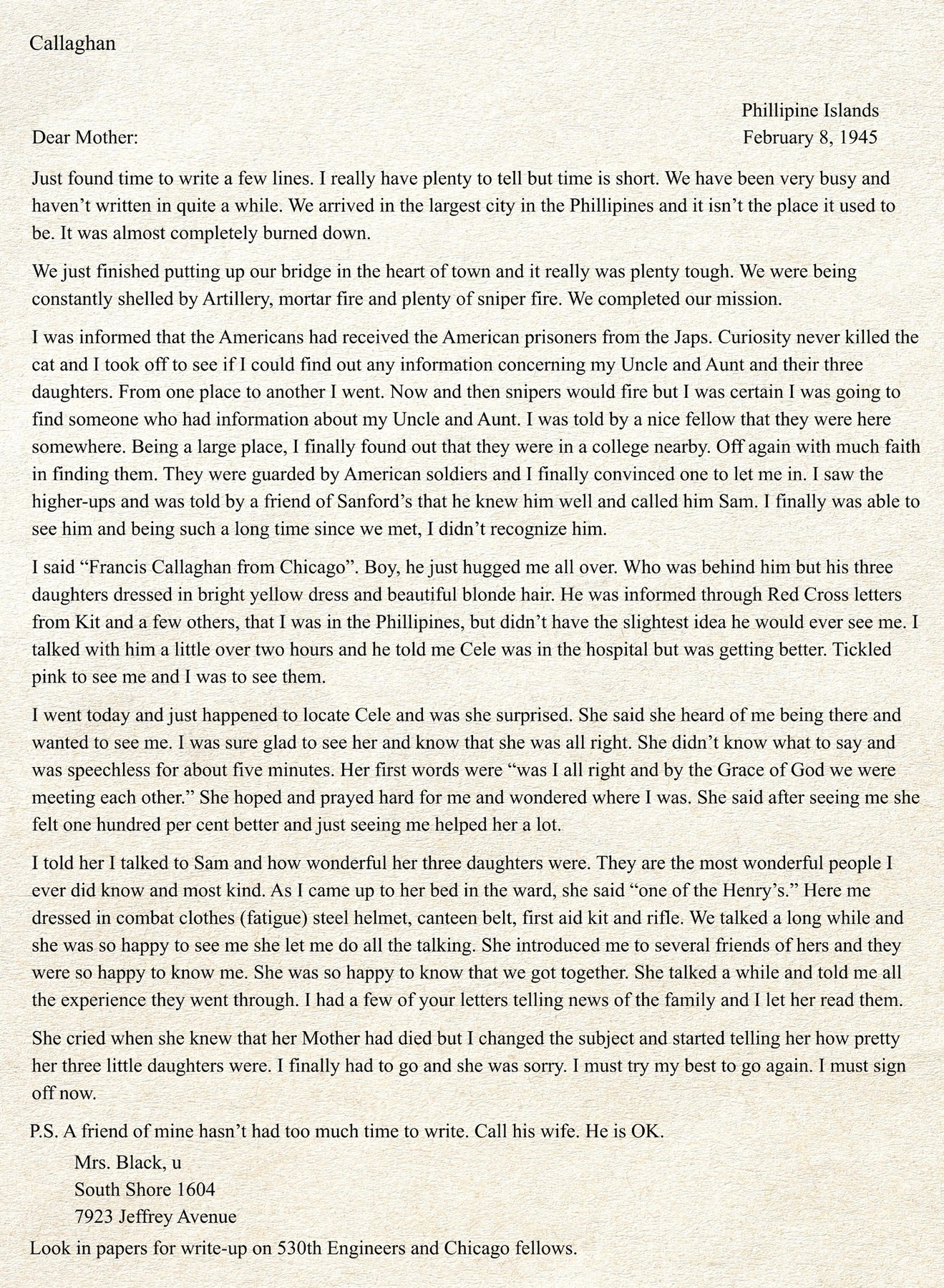
“I said ‘Francis Callaghan from Chicago,’” he wrote in a letter to his mother later that month. “Boy, he just hugged me all over. Who was behind him, but his three daughters dressed in bright yellow dress(es) and beautiful blonde hair.”
Sam Ladic’s wife Mary, who was the cousin of Francis Callaghan, was in the hospital at nearby Santo Tomas Prison and was near death from a severe case of amebic dysentery. The timely arrival of Francis and the U.S. troops, saved her life.
The oldest of the Ladic girls, 12-year-old Mary Ann (Koucky), still remembers the horrors of Bilibid Prison, such as the awful stench of the makeshift graveyard where the Bataan boys who died were hastily buried and the gnawing hunger that was her constant companion.
The 530th spent the balance of the war preparing for the invasion of Japan. If the invasion had been necessary, the Company would have landed on the east coast of southern Kyushu. Japan’s formal surrender on August 15th made these plans moot.
Francis returned home to Chicago in early 1946, and spent much of the rest of his life as a mason, brick layer, and general contractor.
Images from this story