The First American Submarine: Turtle
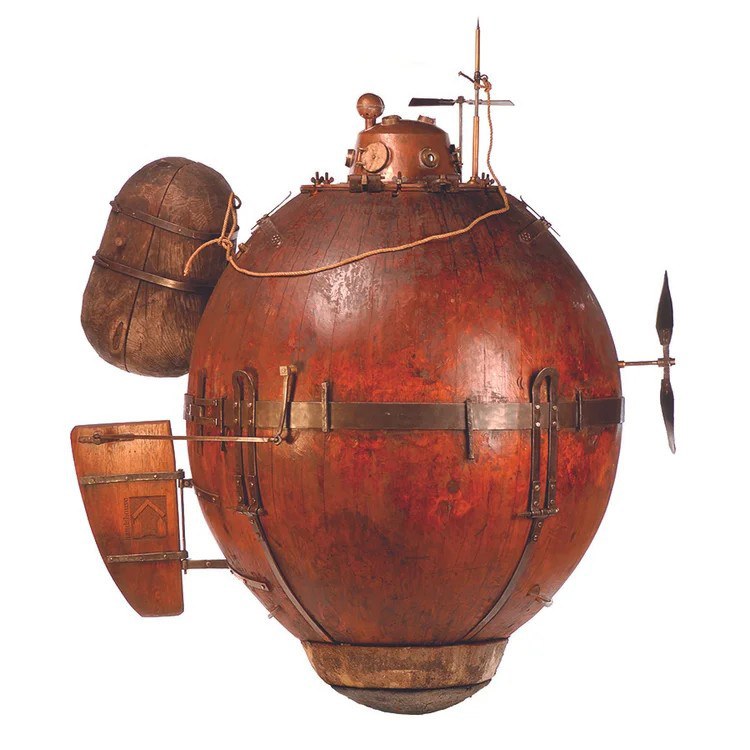
On the evening of September 6, 1776, during the British occupation of New York Harbor, Sergeant Ezra Lee clambered down the narrow conning tower hatch at 10:30 p.m. and set out in the Continental Army submarine, Turtle . Yes, you read that right… A submarine in the Revolutionary War.
Towed downstream by whale boats, Turtle was cast off, undetected. Lee rowed for nearly two and onehalf hours before the tide slackened. As he neared the British Flag Ship HMS Eagle ’s imposing hull, he could see men on deck and hear their voices in the darkness. Lee shut all doors and prepared to submerge beneath the man-of-war’s hull.
His mission was to attach an underwater 150-pound gun powder explosive charge (torpedo) to the hull of the 159 foot, 64-gun, ship of the line in the hope damaging or sinking it. Copper-sheathing, marine growth, or perhaps merely a hard spot in the hull prevented the drill from boring into the ship bottom. After two failed attempts, sunrise was almost upon him, and detection of the Turtle seemed imminent. Lee made the decision to clear the area.
To avoid detection, Lee traveled mostly submerged, surfacing often to get his bearings. Turtle was spotted by British Troops occupying Governor’s Island, New York, and a 6-man boat was dispatched to investigate.
As the British boat approached within roughly 50 yards, he let loose the now-armed torpedo hoping it may destroy the boat and crew. However, the British “took fright”, and returned to the island. The torpedo continued to drift with the tide, passing Governor’s Island towards the anchored British Fleet.
It detonated with a tremendous explosion, alarming the British enough they cut their cables and slipped downstream to the southward of Staten Island.
Lee was eventually spotted by American boats and towed to safety.
The Creation of Turtle
David Bushnell was an inventor and a veteran of the Continental Army during the American Revolutionary War. He was born on August 30, 1740, in Saybrook, Connecticut. A keen mechanic, he enrolled in Yale College at the relatively old age of 31. At Yale, Bushnell conducted experiments with gunpowder, convinced he could explode it underwater. He successfully detonated two ounces and later two pounds of gunpowder in this manner. After refining these experiments, Bushnell focused on inventing a submarine to carry these mines (torpedoes) underwater.
In early 1775, Bushnell built his submarine with his brother Ezra on Poverty Island in the Connecticut River and began testing in July 1775. Throughout the summer, Bushnell conducted multiple successful tests of the submarine with help from fellow Yale graduate Dr. Benjamin Gale.
Gale lauded the Turtle to Benjamin Franklin, who visited Bushnell and his invention in October 1775. Bushnell’s machine came to the attention of the Continental Army and Congress.
By February 1776, Governor Jonathan Trumbull of Connecticut agreed to provide £60 to Bushnell to produce his invention. According to Dr. Gale, the many brass and mechanical parts of the submarine were built by New Haven inventor Isaac Doolittle, whose shop was just half a block from Yale. Doolittle also designed the mine (torpedo) attachment mechanism.
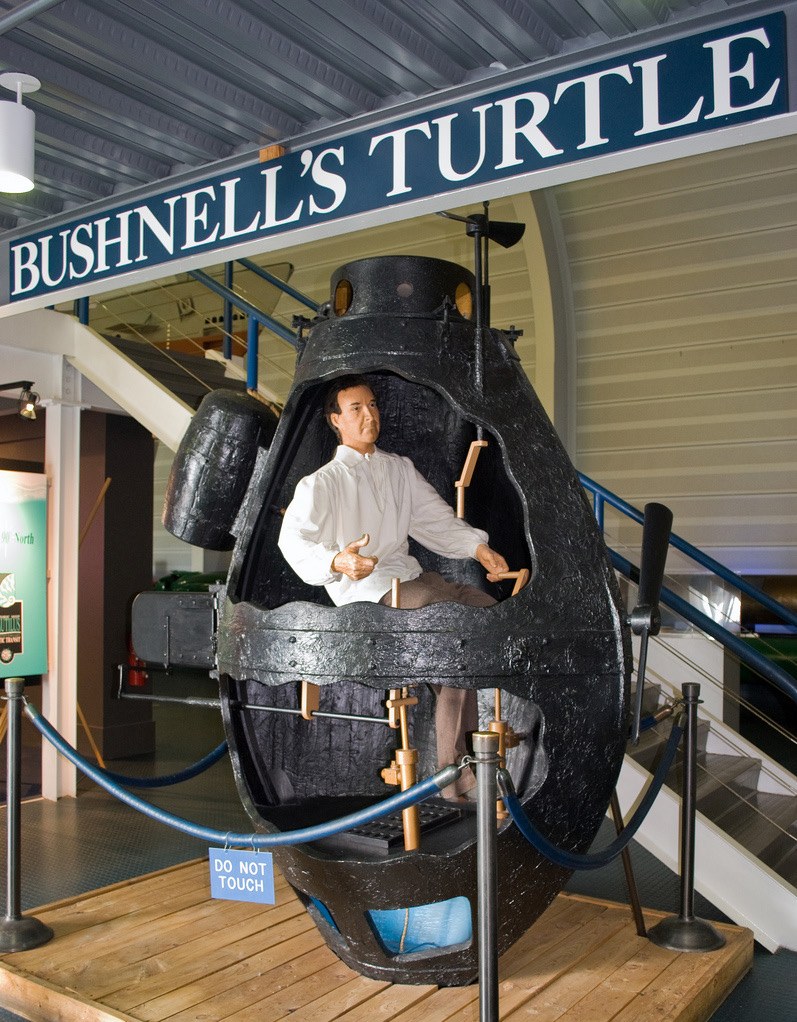
According to Dr. Gale, the Turtle’s dimensions “did not exceed 7 and 1/2 feet from the stem to the higher part of the rudder, and the height did not exceed 6 feet.” Other sources have listed 3.0 meters (9 ft 10 in) length, at the beam measured roughly 0.9 meters (2 ft 11 in). The vessel’s displacement was listed at 91 kilograms (201 lb.). Estimated speed in calm seas was 4.8 kilometers per hour (3.0 mph) and had approximately 30 minutes of operational time when submerged.
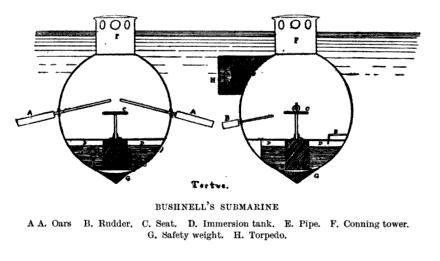
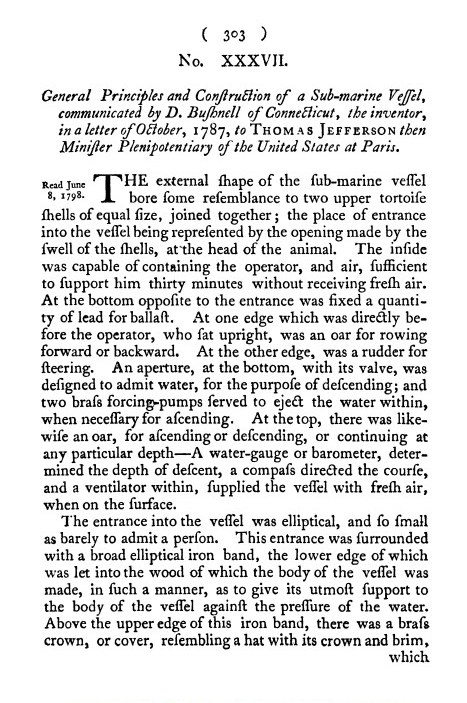
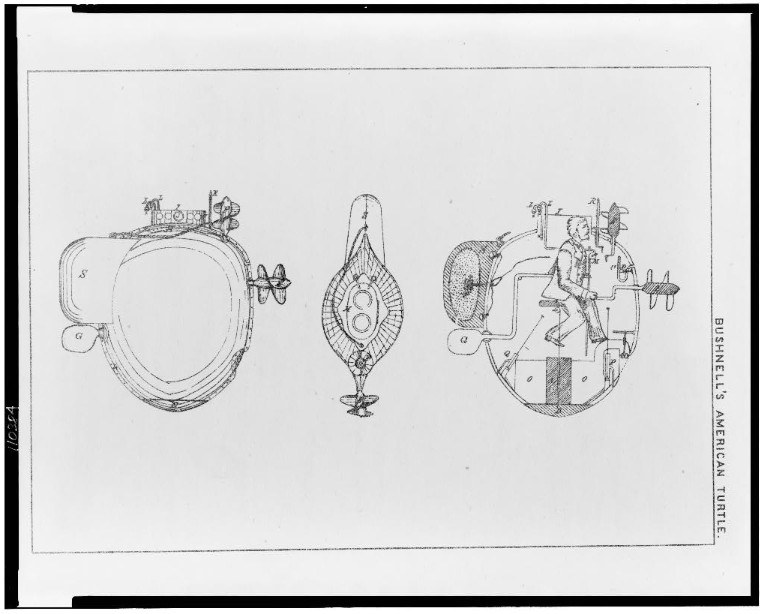
In a letter dated November 9, 1775, from Dr. Benjamin Gale to Silas Deane, a former delegate to the Continental Congress, the “Machine” was described as “constructed of oak, somewhat like a barrel and bound by heavy wrought-iron hoops” with a shape that had “the nearest resemblance to the two upper shells of a Tortoise joined together.”
The brass top, or cover had room for operator’s head and was fitted with eight glass ports located on the sides and top of the cover. Also mounted in the top were two brass tubes, one for fresh air, and the other for ventilation. A fixed barometer was mounted in the hull for depth measurement along with a compass for navigation. The ballast consisted of lead weight in a basket outside the hull, raised and lowered by an interior hand operated cable winch that doubled as an anchor. A foot pump provided the ability to either allow water into the hull or force it out for buoyancy when diving and surfacing basically creating a pressurized hull.
A “pair of oars fixed like the two opposite arms of a windmill” were used to control forward, backward and side to side direction. A third oar provided up and down movement. All oars were turned by foot like a spinning wheel. What Gale was describing is what we call today a propeller.
The mine was carried on the exterior of the hull in a waterproof container. Bushnell designed the mine release and arming system so that once it was attached to a ship, the mine lanyard would pull a pin, starting the watch work timer that was connected to a lock plate firing mechanism. Once time expired, the lock would release and ignite the explosive charge.
Two unsuccessful attempts to blow up British ships were conducted from Fort Lee on Manhattan Island, both thwarted by navigational issues and tides. On October 9, 1776, two British frigates, HMS Phoenix and HMS Roebuck , accompanied by the 20-gun HMS Tartar and three tenders, stood up the lower Hudson River. Ignoring the intense cannonade from Forts Washington and Constitution, the British naval force quickly disposed of a small Continental squadron. Among the American ships lost was the small sloop carrying Turtle.
Lee and Bushnell both escaped injury and reached shore. The first American submarine, however, sank to the bottom of the Hudson. The Turtle was recovered soon afterward but saw no further service. Her eventual fate remains a mystery.
Although David Bushnell’s submarine failed to sink any enemy vessels, he was responsible for several notable achievements.
He proved that gunpowder could explode underwater with sufficient force to disable and sink a surface ship. His experiments and research developed floating and submerged mines and invented the first practical submarine.
He also solved several basic engineering and nautical problems: constructing a watertight and pressure-proof hull with vertical and horizontal propulsion mechanisms; achieving vertical stability and steering control; and developing the means of using variable ballast systems.
Bushnell’s inventions were rapidly improved upon by other U.S. inventors who continued to develop the submarine for use in subsequent U.S. naval conflicts.
While a submarine practical for warfare with range, power and reliability had to await the coming of the mechanical age, Turtle was an indispensable first step, which made future developments possible.
Images from this story